With a legal mandate to protect children and youth from abuse and neglect, the Children’s Aid Society of Toronto (CAST) does essential work to assess, reduce and eliminate the risk of harm. A collaboration through the Data Science’s Institute’s Summer Undergraduate Data Science (SUDS) Opportunities Program supported that work by helping CAST to understand why some child protection cases remain open for extended periods and why re-referrals occur after cases are closed. By analyzing the narrative data alongside administrative outcomes, CAST addressed key challenges and gained insights into decision-making processes at different stages of a child’s involvement with the system.
Equipped with the data science and professional skills that DSI provides to SUDS scholars, the undergraduate interns working with CAST built a dataset of more than 700 cases from over the past three years. This created a foundation for further analysis enabling the team to explore correlations between case narratives and administrative outcomes. They identified key areas for deeper analysis, including trends related to substance use, the role and nature of counselling activities, and patterns across different client groups within the child welfare system. Through DSI, Professor Shion Guha, Faculty of Information, University of Toronto, supervised the research project.
The Bridging Administrative Decisions and Caseworker Narratives: A Computational Exploration of Child Welfare Practices was an opportunity to strengthen collaboration between researchers and practitioners. CAST staff were actively engaged in shaping future research directions, including plans for interviews, focus groups, and design workshops with frontline workers. Altaf Kassam, Director of the Child Welfare Institute, Children’s Aid Society, speaks to the impact of this work. “This partnership brings together our frontline experience and academic expertise, closing the gap between research and practice. It allows us to ask—and answer—questions that neither could tackle alone.”
This positive collaboration established momentum for continued research and innovation, directly leading to another SUDS project in 2026 that focuses on prototyping an AI-supported decision-support tool and testing whether such tools can meaningfully support child welfare decision-making. Through the Participatory Design of a Dual-Data Decision Support Tool for Child Welfare project, CAST is continuing to advance their strategic goal of developing responsible, evidence-informed innovations that enhance service quality and support better outcomes for children and families.
Minahil Bakhtawar is joining the project as a 2026 SUDS Scholar. “This project highlights how interdisciplinary data science truly is. It’s more than just the code and algorithms. The deeper understanding of people and systems and bringing the different sociotechnical elements together paves the way for high impact work that I am incredibly excited to be a part of.”
For undergraduate students who participate in SUDS, the effects last beyond the length of the project itself. The 2025 interns had the opportunity to present their work at the SUDS Showcase 2025.
“One of the most exciting parts of this collaboration has been seeing undergraduate students contribute meaningfully to a complex real-world challenge. Through SUDS, students bring strong data science skills while also learning directly from practitioners working on the frontlines of child welfare,” highlights Prof. Guha.
Collaborations like these are key to DSI’s aim to accelerate the impact of data sciences and AI to address pressing societal questions and drive positive social change. Through the Mitacs Accelerate SUDS Research Internships, CAST was able to leverage their funds for 1:1 matching by Mitacs, and access top University of Toronto undergraduate data science and AI talent to work on their project.
The collaboration with CAST exemplifies the type of big-picture understanding that DSI aims to support in its ecosystem of data science and AI research, training, and connection.
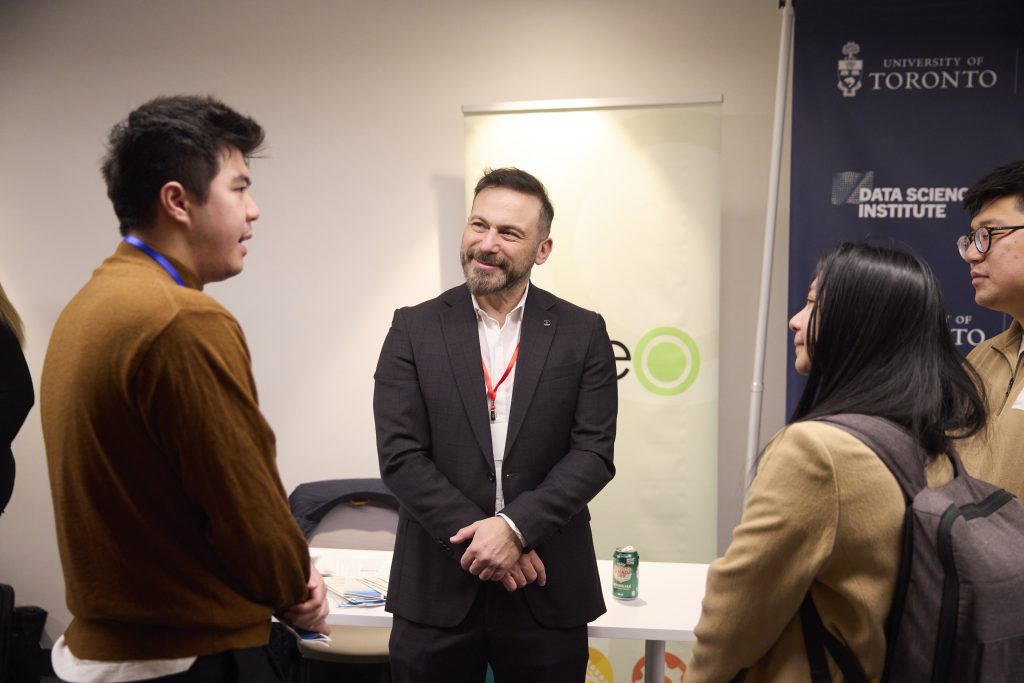
“This collaboration really started with a moment of connection,” says Sumaiya Hossain, Partnership & Business Development Officer, Data Sciences Institute. “At the 2024 SUDS Showcase, we invited Altaf to hear Professor Guha’s keynote on rethinking risk in child welfare algorithms, and it immediately resonated with the work CAST is doing. Seeing that conversation turn into a funded SUDS-Mitacs research project with students is exactly the kind of outcome we hope for when we create spaces for researchers and organizations to meet—it’s how DSI connects ideas, partners, and talent.”