
Understanding an individual person’s aging trajectory is a critical challenge. Much of what we know from brain imaging comes from comparing groups of people, but to inform clinical care, we need to move from what happens on average to tools understanding or predicting what is happening in a particular person. Data science and AI offer enormous potential for helping us make that transition.
On September 28 and 29, a two-day symposium and workshop, part of the Advancing Aging and Neurodegeneration Research through Data Science Emergent Data Sciences Program (EDSP), will examine best practices for designing, conducting, and analyzing multi-site neuroimaging studies of aging and neurodegeneration. This EDSP was designed to bring together researchers who are interested in using data science to advance our understanding of brain aging and neurodegenerative disease.
Dr Rosanna Olsen is Senior Scientist, Rotman Research Institute (RRI), Baycrest; Associate Professor, Affiliated Scientist, Department of Psychology in the University of Toronto Faculty of Arts & Science, and co-lead of the Advancing Aging and Neurodegeneration Research through Data Science Emergent Data Science Program. She says, “We have a great deal of expertise across the University of Toronto and its affiliated institutions, and we have also brought international experts to Toronto to share approaches that may be new to our community. The idea is not simply to hear about these methods, but to bring what we learn back to our laboratories and incorporate it into our own research.”
With support from DSI, the program has created opportunities for researchers and trainees around the GTA to learn about some of the most cutting-edge methods being developed in brain imaging, artificial intelligence and data science.
The creation of very large MRI datasets, often by combining data collected at different research centres around the world, has created opportunities to ask questions that would be impossible to address in a single laboratory. But it also creates new challenges as different scanners can produce subtly different measurements. Approaches like data harmonization are important ways of distinguishing these technical differences from genuine biological differences between people.
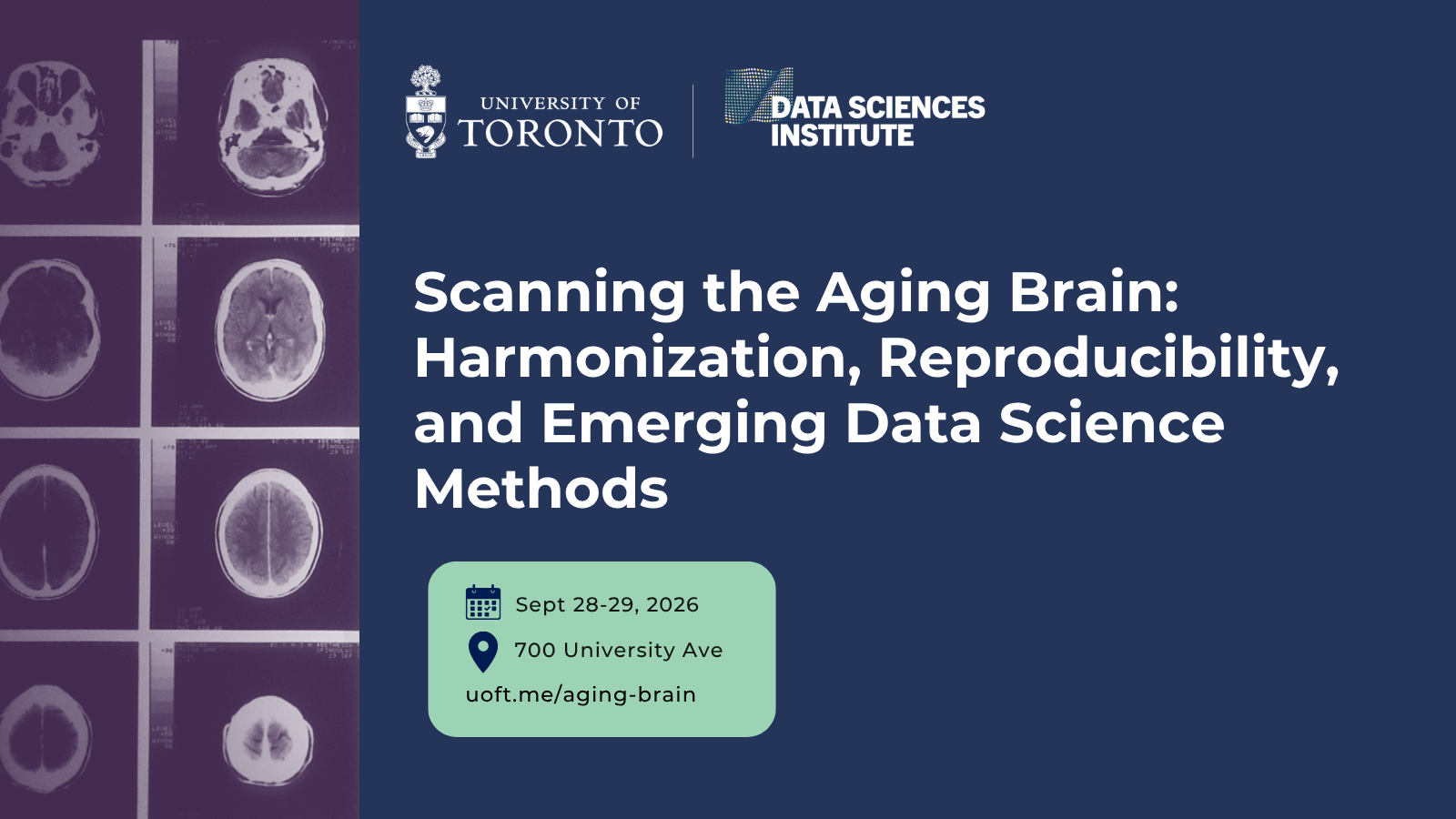
Over two days, Scanning the Aging Brain: Harmonization, Reproducibility, and Emerging Data Science Methods will bring together speakers from across Canada, the United States, and Australia.
“One of the things we are most excited about is bringing together speakers who have complementary expertise, but who don’t necessarily approach these problems in exactly the same way. We expect that to create a very high level of engagement — not only among the speakers, but also between the speakers and the audience.”
The event will consider challenges that arise throughout the research lifecycle, from initial study planning and protocol development to scanner upgrades, unexpected acquisition changes, data processing, statistical analysis, and clinical translation.
Rather than simply presenting a single “best” way to do things, the aim is to critically examine how different methodological choices affect the conclusions we draw about the aging brain.
“Having experts in harmonization, reproducibility and different imaging and data science methods together in the same room gives us an unusual opportunity to make connections across areas that are often discussed separately,” says Dr Olsen. “Methodological advances often develop within particular research communities, even when they could be extremely useful to scientists working in adjacent fields. These communities may operate in relative isolation, so researchers may not even realize that a solution to a problem they are struggling with already exists somewhere else.”
When planning this event, the team deliberately invited scientists working across somewhat different areas of brain imaging and data science. The goal is for ideas to cross disciplinary boundaries — for someone to hear an approach being used in another field and think, “We could use that in our data.”
“The DSI’s support makes that kind of exchange possible,” says Dr Olsen. “We want researchers and trainees to leave the event with practical ideas that they can apply to the design, analysis and interpretation of their own studies. Longer term, we hope the discussions lead to new collaborations, more reproducible approaches to multi-site neuroimaging, and better ways of extracting meaningful information about aging and neurodegenerative disease from increasingly large and complex datasets.”s
Scanning the Aging Brain: Harmonization, Reproducibility, and Emerging Data Science Methods
September 28-29, 2026
In person
Data Sciences Institute,
Seminar room
10th floor,
700 University Avenue