Cate MacLeod

DSI welcomes Baycrest as a partner

The Data Sciences Institute (DSI) is excited to announce a new partnership with Baycrest. Baycrest is a leader in cognitive neuroscience and memory research, with the goal of transforming the journey of aging. The Baycrest Rotman Research Institute (RRI) advances the understanding of human brain structure and function in critical areas of clinical, cognitive, and computational neuroscience, including perception, memory, language, attention, and decision making. With a primary focus on aging and brain health, including Alzheimer’s and related dementias, research at the RRI and across the Baycrest campus promotes effective care and improved quality of life for older adults through research into age- and disease-related behavioural and neural changes.
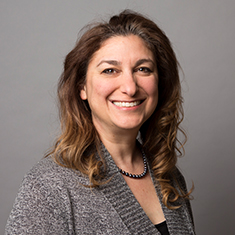
Allison Sekuler from Baycrest.

“This partnership will help Baycrest expand our potential for meaningful impact, catalyzing the transformative nature of data science to make the most of our behavioural, clinical, and neuroimaging data,” says Allison Sekuler, President and Chief Scientist, Baycrest Academy for Research and Education at the Baycrest Centre for Geriatric Care. 

Canada is aging faster than ever before, and the pandemic shone a light on the vulnerability of older adults and exacerbated the public health crisis of dementia. We urgently need to address this critical societal issue, but that requires new ways of working together. Connecting with the data science community through the DSI will forge new collaborations and research opportunities, helping us create a world where all older adults can live their best possible lives.

DSI collaborates with organizations eager to support world-class researchers, educators, and trainees advancing data sciences. We facilitate inclusive research connections, supporting foundational research in data science, as well as supporting the training of a diverse group of highly qualified personnel for their success in interdisciplinary environments. As one of our external funding partners, Baycrest researchers can apply for research grants, training and networking opportunities at the DSI.

We are very excited to announce this partnership. Our goal is to create a central hub to elevate data science research, training, and partnerships. By connecting data science researchers, data and computational platforms, and external partners, the DSI will both advance research and nurture the next generation of data- and computationally focused researchers. We are thrilled to have Baycrest researchers join the DSI community.

Advancing data science discovery via software development support

Data Sciences Institute announces its first software development support

Data science research is becoming increasingly reliant on complex computer programming, but many researchers lack the training or experience in software engineering to develop effective and reliable software. The Data Science Institute (DSI) software development program supports faculty and scientists at the University of Toronto and external funding partners to accelerate their research by providing access to highly skilled software developers to refine or enhance existing software and improve usability and robustness, build new tools, and disseminate research software. The DSI hopes to help develop software for researchers that can be accessed across disciplines and support reproducible processes.

Coming out of the first call for this competitive program, six researchers and their teams will be able to work with a DSI software developer to build high quality and adaptable software. The research projects reflect a wide range of fields, from humanities, social sciences, and life sciences.

With over 25 applications, we had a tremendous response for this first competitive call for DSI support. It was exciting to learn about the wide range of research projects needing software support at UofT. We are working to increase capacity for this important program to better support the cutting-edge research, while supporting the collaboration, equitable and open science principles at the DSI,

A key part of creating collaborative, reusable software is ensuring that source code is available to the broader research community. To that end, DSI-supported research software will be publicly available and documented on GitHub, and GitHub will also be used to track projects and progress towards milestones.

There is so much data in the world now. This is a transformational change. Some researchers are very savvy with it, but others are just discovering it, and we are here to support them. I see myself as more of a technician, it’s really about the researchers and their teams and what they want to achieve. It has been exciting to be part of these projects,

The next call for DSI research software developer support will be announced later this year.

Developing a web interface to help speech researchers

Ewan Dunbar and his team from the Department of French in the Faculty of Arts & Science, are working with the DSI to create a web interface that allows speech researchers to upload audio files and download “speech features” useful for speech processing. This software is helpful for many experimental and clinical speech researchers. However, installing it currently not only requires Python, but also dependencies that do not work on Windows. Once completed, Speech Features Online (SFO) will let users upload large audio datasets and select among available speech features with ease.

We are very excited about this project and thrilled to work with the DSI. We want to have a tool, but we also want to make it accessible, by taking research code and bundling it, so researchers know that it’s usable and understand what it’s doing. That takes a lot of work, and it’s really a software development task,

Professor Dunbar’s research focuses on human speech perception, automatic speech processing, and understanding the cognitive processes going on in the human brain. As a speech researcher, Dunbar is also working on tackling a major problem, the fact that speech technology is currently limited to a few languages for which researchers have access to lots of transcribed audio data, such as English.

The full list of projects from the DSI’s Research Software Development Support Program

Alan Moses from the Department of Cell & Systems Biology, Faculty of Arts & Science, and Julie Forman-Kay from The Hospital of Sick Children will work with the DSI to create a software program to help the research community with intrinsically disordered regions, which are protein sequences that do not take on a stable secondary or tertiary structure.

Dorothea Kullmann from the Department of French, Faculty of Arts & Science will work with the DSI to develop a database that will consist of two interrelated parts: 1) a catalogue of the late medieval manuscripts of this type kept in Canada; and 2) a text corpus of the French texts contained in these, and other manuscripts of the same type kept anywhere in the world.

Eunice Eunhee Jang from the Department of Applied Psychology and Human Development, OISE (Ontario Institute for Studies in Education) is working on curriculum-based learning tools that assess and track children’s emergent literacy and language development. Most standardized assessments are only designed to measure exceptionalities and are often inaccessible to parents and teachers. Working with DSI developers, the BalanceAI Discovery digital assessment tool addresses this gap.

Ewan Dunbar from the Department of French, Faculty of Arts & Science is working with DSI software developers to create a web interface that allows speech researchers to upload audio files and download “speech features” useful for speech processing.

Gregory Schwartz, University Health Network, and his team identified rare cancer cells which may contribute to disease progression. He will work with DSI developers to better understand cellular heterogeneity, by developing a suite of tools for clustering and visualizing single-cell data called TooManyCells.

Laura C. Rosella, Dalla Lana School of Public Health and Birsen Donmez, Department of Mechanical and Industrial Engineering, Faculty of Applied Science and Engineering will be working with DSI developers to apply Human Factors Engineering methods to build a user-friendly decision support tool for the Chronic Disease Population Risk Tool (CDPoRT). CDPoRT was developed and validated using population-level health system data to predict the future burden of chronic diseases.

Applications open for Data Access Grants

Grants of up to $10,000 are available to cover costs associated with accessing and working with large data sources. These DSI grants aim to improve data accessibility for data science researchers and foster research by mitigating the high cost of access to data sets. We believe that equitable access to resources is crucial for creating a diverse and inclusive environment.

Deadline for applications: April 29

Applications open for Seed Funding for Methodologists

This Seed Funding is designed to encourage new collaborations between data science methodologists and theorists with applied researchers. Single applicants working in data sciences methodology or theory can apply. An applicant’s research area should focus on data sciences methodology or theory with the potential to be relevant to applied fields.

Applicants will present their research and methodology/theory at a seminar, including its potential for applied fields. Funds of up to $10,000 can be used over 8 months to support successful applicants to seed a new Collaborative Research Team with the aim of applying for a DSI Catalyst Grant.

Deadline for applications: April 14

Reproducibility: The heart of the research method

Data Sciences Institute Reproducibility Thematic Program

The growing use of large-scale complex data across disciplines has brought the challenge of reproducibility to the forefront. But how can we foster trust in data-informed research? The Data Sciences Institute (DSI) Reproducibility Thematic Program aims to address such questions by focusing on the development of widely adoptable methodology and processes to share data and code, as well as the development of infrastructure, methods, and models that support reproducible and reliable research. Ambitions for the program include educating the next generation of researchers on the importance of transparency, removing the intimidation factor from reproducibility, and supporting researchers in identifying their path to reproducibility.

“There is a lot of discussion about how the lack of reproducible results may make people question their confidence in science. We saw this play out during the pandemic. Robust and reproducible processes are paramount to maintaining confidence in the research enterprise and ensuring the generation of reliable results upon which science builds. We want to push to make the DSI a centre for reproducible science, and help researchers understand how to adopt best practices in reproducibility,” says Timothy Chan, DSI associate director of research and thematic programming.

Last fall, the DSI held an open call for researchers to co-lead this thematic program. Reproducibility co-leads Professors Rohan Alexander, Benjamin Haibe-Kains and Jason Hattrick-Simpers represent different research fields– from social sciences to life and physical sciences – but they are united in their passion for supporting and advocating for transparency and reproducibility in research. They are in the process of developing programs and community-building activities.

Stay tuned for Reproducibility activities and opportunities.

2022 Toronto Workshop on Reproducibility

The Reproducibility Thematic Program kicked off with a multi-day workshop that brought together over 460 academic, industry, and non-profit participants on the critical issue of reproducibility in applied statistics and related areas. The workshop was hosted by the DSI and CANSSI Ontario.

Toronto Workshop on Reproducibility

Topics at the workshop ranged from reproducibility in language modelling and machine learning, to biomedical research, to integrating reproducibility in undergraduate social science programs and reproducibility in crowd science.

The workshop featured over forty speakers from the University of Toronto, University Health Networks, Canadian and International research universities and focused on evaluating and teaching reproducibility, as well as reproducibility practices. “We were tremendously pleased with the caliber of the speakers,” says Rohan Alexander, the lead organizer. “The deep engagement speaks to the importance of reproducibility. To create understanding it is important that others can trust results.”

Reproducibility champion and world-renowned computer scientist, Professor Joëlle Pineau, spoke to improving reproducibility in machine learning research. “Reproducibility is a minimum necessary condition for a finding to be believable and informative,” says Pineau, an associate professor at the School of Computer Science at McGill University. She co-directs the Reasoning and Learning Lab at McGill and also leads the Facebook AI Research lab.

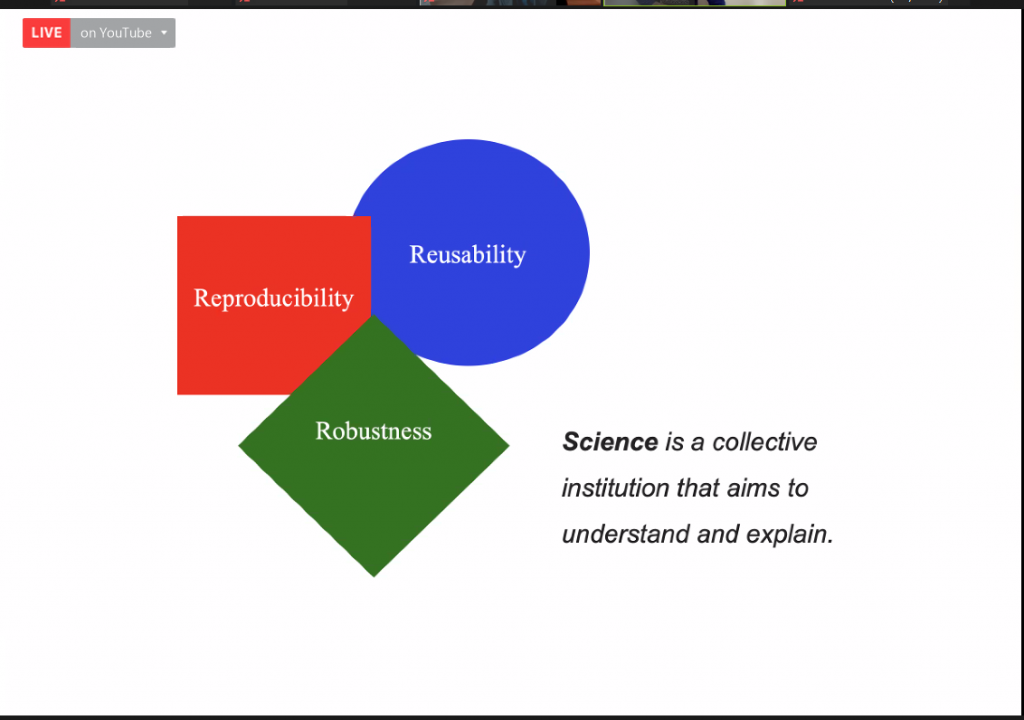
Presentation slide from Reproducibility Workshop.

Professor Colm-Cille Patrick Caulfield from the University of Cambridge discussed why an honest discussion of uncertainty in models is critical for climate science. “We have such a complex climate system, only by ensuring transparency can we be 100% confident in our predictions,” Caulfield says. The DSI and the C2D3 Cambridge Centre for Data-Driven Disc are planning to host joint workshops around the DSI’s Thematic Programs of Inequity and Reproducibility.

Meet the Reproducibility Co-Leads

The DSI is excited to announce co-leads for its Thematic Program in Reproducibility. The co-leads are responsible for the thematic program events, activities, and community-building.

Rohan Alexander is an assistant professor at the Faculty of Information and Department of Statistical Sciences at the University of Toronto. He is the assistant director of CANSSI Ontario, a senior fellow at Massey College, and a faculty affiliate at the Schwartz Reisman Institute for Technology and Society. He is interested in using statistics to understand the world.

“I am particularly interested in how we turn something as complicated as society into a dataset that can be analyzed, and what we lose in exchange for the benefits that such statistical modeling brings. I applied to be a Reproducibility co-lead to contribute to the improvements that are happening in the social sciences and to share and learn from other disciplines.”

Benjamin Haibe-Kains is a senior scientist with the University Health Network and an Associate Professor of Medical Biophysics at the Temerty Faculty of Medicine. His research program focuses on developing multimodal models, using radiological images and large-scale genomic data, to predict the survival and therapy response of cancer patients.

“I have always been passionate about research transparency and reproducibility, key components of Open Science. When I saw that the newly created Data Sciences Institute had an open call for leading their Reproducibility Theme, I could not miss this unique opportunity to educate on how to make research more transparent and reproducible.”

Jason Hattrick-Simpers is a Professor at the Department of Materials Science and Engineering, at the University of Toronto and a Research Scientist at CanmetMATERIALS. His research focuses on the creation of tools to enable the discovery of new corrosion-resistant materials or new materials for converting waste heat into usable energy.

“Reproducibility is at the heart of the scientific method and is what allows us to live in a world filled with technological wonders.”