Uncategorized

DSI SUDS Scholars leverage data science and AI in support of Children’s Aid

With a legal mandate to protect children and youth from abuse and neglect, the Children’s Aid Society of Toronto (CAST) does essential work to assess, reduce and eliminate the risk of harm. A collaboration through the Data Science’s Institute’s Summer Undergraduate Data Science (SUDS) Opportunities Program supported that work by helping CAST to understand why some child protection cases remain open for extended periods and why re-referrals occur after cases are closed. By analyzing the narrative data alongside administrative outcomes, CAST addressed key challenges and gained insights into decision-making processes at different stages of a child’s involvement with the system.

Equipped with the data science and professional skills that DSI provides to SUDS scholars, the undergraduate interns working with CAST built a dataset of more than 700 cases from over the past three years. This created a foundation for further analysis enabling the team to explore correlations between case narratives and administrative outcomes. They identified key areas for deeper analysis, including trends related to substance use, the role and nature of counselling activities, and patterns across different client groups within the child welfare system. Through DSI, Professor Shion Guha, Faculty of Information, University of Toronto, supervised the research project.

The Bridging Administrative Decisions and Caseworker Narratives: A Computational Exploration of Child Welfare Practices was an opportunity to strengthen collaboration between researchers and practitioners. CAST staff were actively engaged in shaping future research directions, including plans for interviews, focus groups, and design workshops with frontline workers. Altaf Kassam, Director of the Child Welfare Institute, Children’s Aid Society, speaks to the impact of this work. “This partnership brings together our frontline experience and academic expertise, closing the gap between research and practice. It allows us to ask—and answer—questions that neither could tackle alone.”

This positive collaboration established momentum for continued research and innovation, directly leading to another SUDS project in 2026 that focuses on prototyping an AI-supported decision-support tool and testing whether such tools can meaningfully support child welfare decision-making. Through the Participatory Design of a Dual-Data Decision Support Tool for Child Welfare project, CAST is continuing to advance their strategic goal of developing responsible, evidence-informed innovations that enhance service quality and support better outcomes for children and families.

Minahil Bakhtawar is joining the project as a 2026 SUDS Scholar. “This project highlights how interdisciplinary data science truly is. It’s more than just the code and algorithms. The deeper understanding of people and systems and bringing the different sociotechnical elements together paves the way for high impact work that I am incredibly excited to be a part of.”

For undergraduate students who participate in SUDS, the effects last beyond the length of the project itself. The 2025 interns had the opportunity to present their work at the SUDS Showcase 2025.

“One of the most exciting parts of this collaboration has been seeing undergraduate students contribute meaningfully to a complex real-world challenge. Through SUDS, students bring strong data science skills while also learning directly from practitioners working on the frontlines of child welfare,” highlights Prof. Guha.

Collaborations like these are key to DSI’s aim to accelerate the impact of data sciences and AI to address pressing societal questions and drive positive social change. Through the Mitacs Accelerate SUDS Research Internships, CAST was able to leverage their funds for 1:1 matching by Mitacs, and access top University of Toronto undergraduate data science and AI talent to work on their project.

The collaboration with CAST exemplifies the type of big-picture understanding that DSI aims to support in its ecosystem of data science and AI research, training, and connection.

“This collaboration really started with a moment of connection,” says Sumaiya Hossain, Partnership & Business Development Officer, Data Sciences Institute. “At the 2024 SUDS Showcase, we invited Altaf to hear Professor Guha’s keynote on rethinking risk in child welfare algorithms, and it immediately resonated with the work CAST is doing. Seeing that conversation turn into a funded SUDS-Mitacs research project with students is exactly the kind of outcome we hope for when we create spaces for researchers and organizations to meet—it’s how DSI connects ideas, partners, and talent.”

Big ideas meet industry impact: Top talent and industry leaders build new connections at the DSI Talent Showcase

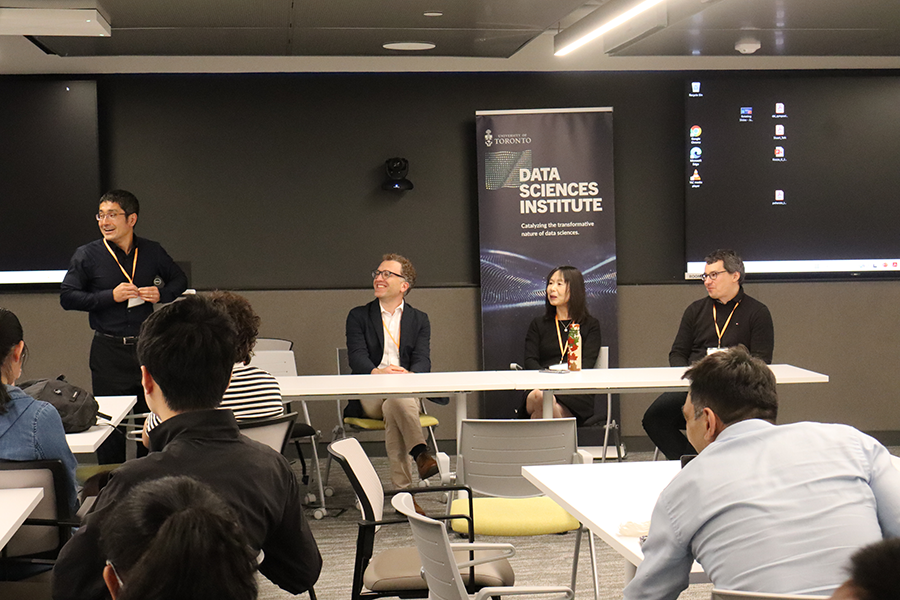
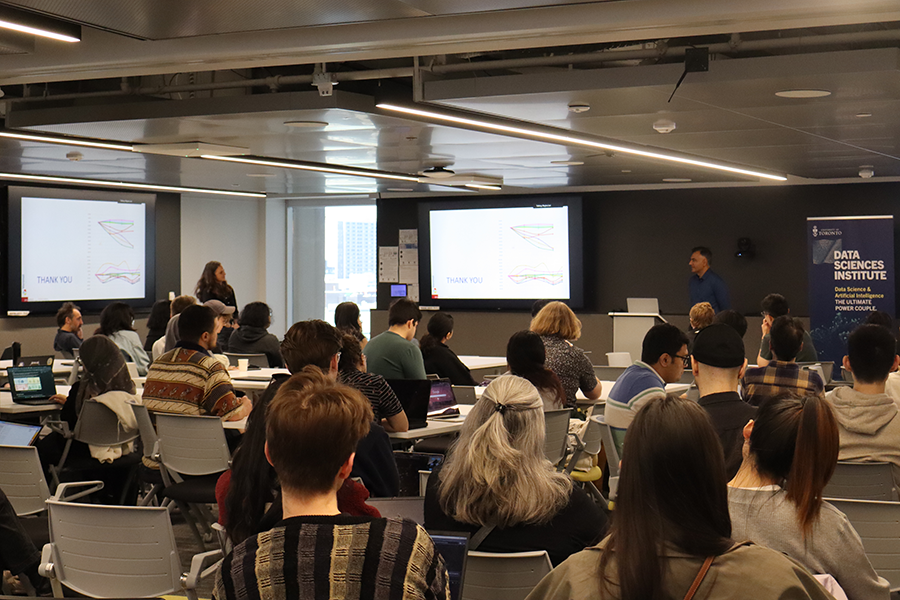
The data science and AI community was aglow on January 22 as a standing room only crowd of industry leaders, researchers and top data science and AI talent gathered for the Talent Showcase at the University of Toronto Data Sciences Institute (DSI).

The Data Sciences & AI Talent Showcase is a unique opportunity for companies and organizations to build new connections with emerging data researchers equipped with cutting-edge skills. This is a way to engage with talent beyond resumes and interviews – companies can see talent in action.

Representatives from organizations across a range of sectors engaged with DSI scholars trained in data sciences, and AI methods and tools that align with industry needs. Industry Partner AstraZeneca Canada, sponsors BMO and Global Affairs Canada brought with them opportunities to recruit, collaborate and connect, and shared perspectives and opportunities.

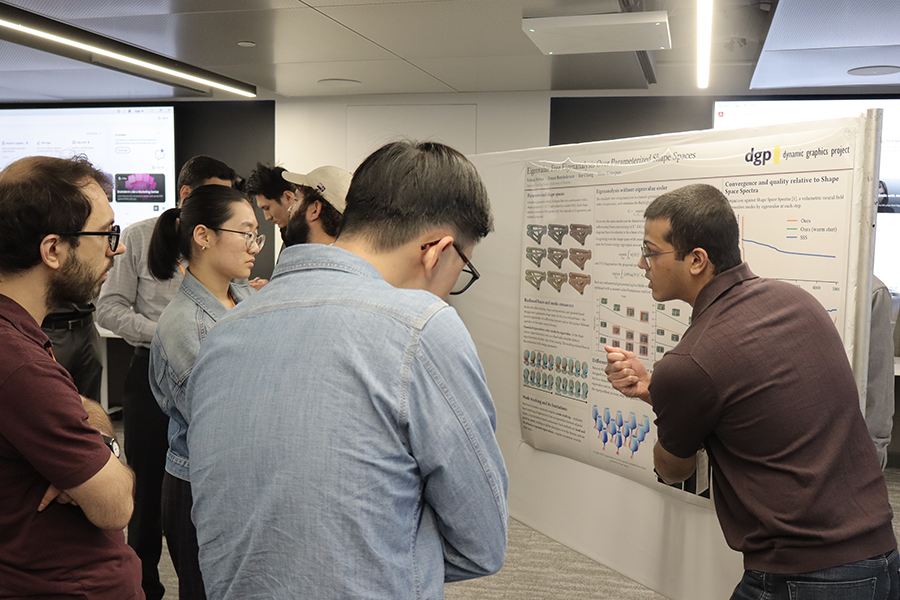
The poster session showcased applied research from undergraduate and doctoral students, and postdoctoral fellows. Drawn from across the U of T and research institute partners, their projects spanned AI and ML, health and genomics, environment and sustainability, policy and governance, and the physical sciences.

For Sejal Bhalla, a DSI Doctoral Student Fellow who presented Utilizing Speech as a Biosignal for Monitoring Respiratory Health and Beyond, the Showcase was an opportunity to learn from peers and multiple industry perspectives. “I work a lot on health monitoring, and I wanted to learn what kind of career options AstraZeneca Canada offers, what kind of research, what kind of R&D they are invested in right now, and find where there’s an overlap. And it was also interesting to see Global Affairs Canada and see both an industry and government perspective, see what kind of things the government is doing within the data science and AI space.”

Noor Khan, a Summer Undergraduate Data Science (SUDS) Scholar, prepared her poster, Examining the Impact of Built Environment Factors on Breast Cancer Risk among BRCA Mutation Carriers in Canada by applying the skills she developed through SUDS.

“Through SUDS I learned a lot about programming, Python, different languages that I could use. I also learned a lot about machine learning and different data science elements that apply to my own research at Women’s College Hospital.”

DSI-affiliated undergraduate and doctoral students, and postdoctoral fellows share their applied research with industry leaders and the U of T community.

Dr. Nardin Samuel delivered the keynote, reflecting on the transition from academic research to real-world application, with a focus on identifying meaningful research gaps and translating scientific insight into practical tools. Dr. Samuel is a physician-scientist, neurology resident, and the visionary CEO & Co-founder of Cove Neurosciences, a groundbreaking software venture transforming how brain data is analyzed. Drawing on her experience working at the intersection of neuroscience, data science, and technology, she discussed the lessons learned from navigating commercialization without formal business training.

The Showcase featured Daniel Smedley, Vice President, Innovation & Business Excellence and IT at AstraZeneca Canada, a DSI Industry Partner. AstraZeneca Canada is collaborating with — and investing in — emerging talent who share their vision of using data to transform science and deliver life-changing medicines.

“At AstraZeneca, we build, buy and use AI across all parts of our business, and robust data is critical in achieving our AI ambition,” says Smedley. “For any type of data role at AstraZeneca Canada, technical ability is the foundation, but that’s paired with the ability to engage with a wide stakeholder set, understand the problem that we’re trying to solve, and to work cross-functionally and collaborate with each other to make it happen. We are so pleased to be here today to connect with emerging talent whose applied research shows that same vision of using data to solve problems that matter.”

Partnering with the DSI enables AstraZeneca to create greater patient impact through pharmaceutical innovation shaped by data, AI, and advanced analytics. Through this partnership, AstraZeneca plays a key role in the DSI Talent Showcase, Industry Speaker Series and as a partner for collaboration.

Daniel Smedley, Vice President, Innovation & Business Excellence and IT at AstraZeneca Canada, presents on data science and AI at AstraZeneca.

Leadership from sponsors BMO Canada and Global Affairs Canada were also looking to recruit from among DSI-affiliated undergraduate and doctoral students, and postdoctoral fellows.

Talent Showcase attendees speak to Victoria Cabral (Senior Manager - Canada - Campus & Early Talent Recruitment) and Roxana Sarea (Senior Recruitment Partner - Emerging Technology) at the BMO Canada booth.
Maher Mamhikoff, Director of Data, AI & Performance at Global Affairs Canada speaks to Talent Showcase attendees at the Global Affairs Canada booth.

Madeleine Bonsma-Fisher, a DSI Postdoctoral Fellow whose poster, Bicycle route choice modelling in Toronto, won the Showcase prize for Outstanding Research Question and Impact, reflected on what it meant to be part of the showcase after her win.

“It’s so nice to be at an event like this where there’s people from all different sectors, like industry, government, research, across so many disciplines. It’s a really energizing space and it’s just great to be a part of it. It’s a pleasure to talk about my research and talk to curious people who are doing so many cool things.”

Lisa Strug, Director, Data Sciences Institute, reflects on the Showcase’s impact. “The inspirational Showcase is a testament to DSI’s mandate to help shape the evolution of the data science field and the University of Toronto’s leadership role bringing data science and AI training to new domains and organizations.”

The Data Sciences Institute welcomes industry leaders ready to be part of future collaborations. Our Industry Partnership model connects industry leaders with top-tier data science, fostering collaboration through industry engagement and  trainee development opportunities. Organizations gain direct access to exceptional students and researchers, strengthening their presence in the next generation of data-driven talent. See our Industry Partnership Model and contact parterships.dsi@utoronto.ca to get started.


Photos by Harry Choi.

Thank you to our
Industry Partner


Thank you to our sponsors

Related events

U of T staff: Level up your AI skills with the Data Sciences Institute!

University of Toronto staff who want to build the skills and confidence to apply generative AI effectively in their work have a new opportunity for learning with the Data Sciences Institute.

With AI becoming increasingly important for work, the University’s AI Task Force’s report, Toward an AI-Ready University, calls for AI literacy and training for all employees.

Deploying AI offers a unique value as it is short, targeted learning experience dedicated to the frameworks, tools, and applied skills that professionals need to navigate the operational and organizational challenges of AI integration. The microcredential emphasizes real-world applications and toolsets, enabling learners to contribute to AI integration initiatives in their workplaces. Participants gain in-demand expertise in model evaluation, prompt engineering, and navigating deployment frameworks.

The microcredential builds on the success of the DSI Data Science and Machine Learning Software Foundations Certificates offered with the financial support of Upskill Canada, powered by Palette Skills and the Government of Canada.

DSI is a hub for learning data science and AI and has offered not-for-credit data science, machine learning and AI certificates and microcredentials for several years for professionals outside U of T. DSI also offers certificates for doctoral students in collaboration with the School of Graduate Studies, and the Machine Learning Bootcamp for Faculty members offered with the Centre for Analytics and Artificial Intelligence Engineering (CARTE).

U of T staff can now also register for DSI’s microcredentials. Starting with Deploying AI, offerings will be searchable on the Centre for Learning, Leadership & Culture learning management system for U of T staff as they are scheduled throughout the year. 

To celebrate this opportunity for U of T staff, we spoke to Philip Rudz, a Faculty of Arts & Science staff member who completed Deploying AI in the fall.

Philip works in the Dean’s Office as a Service and Technology Delivery Lead, Teaching & Learning.

“A significant part of my role is evaluating new tools and technologies to stay current of what our instructors and administrative staff might be exposed to or request to use.”

Philip had experimented with Generative AI and various machine learning tools for several years. “I am part of the Arts & Science Dean’s Advisory Committee on AI,” he said, “And I have delivered several workshops to A&S admin staff about GenAI and also took part in developing the governance and data security guidelines as part of the AI Task Force that was convened in 2024-25.”

Still, Philip says he wanted exposure to a more formal instructional setting as opposed to self-learning. “The quality of instruction was excellent,” he says, “and the instructor and support staff were really outstanding.”

“I anticipated that the cohort would be more technical than me – which I thought would be valuable experience. I also wanted insight into what folks in the private sector were doing with AI implementation and was not disappointed as it was a large and diverse cohort. I really appreciated the expectation that students would be familiar with the basics of Python and that the instructor never slowed down the pace. I found the exercises challenging, but not overly so, and well designed to cater to a range of experience levels.”

Bill Brennan, Assistant Director, Learning and Leadership Development, Centre for Learning, Leadership & Culture in the Division of People Strategy, Equity & Culture, is enthusiastic about the inclusion of Deploying AI for U of T staff.

“For those looking to build on existing programming knowledge, the Deploying AI microcredential is an opportunity to gain hands-on, practical skills, to meet our needs to support AI literacy for U of T employees” he notes.  

Registration is open for the February session of Deploying AI ! U of T staff may be eligible to apply for the Staff Tuition Waiver, depending on their employee group and how the learning relates to their role.

DSI Launches Unique Microcredential in Genetic Data Analysis

The human genome contains billions of molecules, and small variations within them can influence biological processes, traits, and disease. As the volume and complexity of genomic data grow, so does the need for researchers with specialized skills in genomic data analysis.

To meet this need, the Data Sciences Institute is launching the new Genetic Data Analysis Toolbox. This 6-week microcredential provides focused, hands-on training in tools and methods to analyze and interpret data generated by modern genomics technology.

Demand is growing for professionals with applied genomic data skills across biomedical research, clinical settings, and the biotechnology, pharmaceutical, agricultural, and forestry sectors. The Genetic Data Analysis Toolbox bridges the gap between traditional academic training and practical data skills required for today’s data-intensive projects. It is well suited for researchers, graduate students, and professionals who are working with, or preparing to work with, genomic datasets in academic, clinical, and applied settings.

In Genetic Data Analysis Toolbox, learners gain experience with contemporary software such as PLINK, MAGMA, and GRAF-pop, and receive an introduction to genome-wide association studies (GWAS) and population genetics methods. While participants are required to have a basic understanding of R, the microcredential is designed for learners with limited computational or statistical backgrounds.

“We are incredibly excited to be launching the first microcredential of this kind in Canada,” says Lisa Strug, Director, Data Sciences Institute and Tier 1 Canada Research Chair in Genome Data Science. “Through interdisciplinary training in genomics, data and computational science, we are able to fill a critical gap for research in the life and health sciences and prepare learners with applied and reproducible data science skills that are essential for clinical, academic, and industry settings.”

Unlike broader bioinformatics or genomics programs, this training is focused on genetic association studies, population genetics, and genome-wide analysis workflows. Learners develop hands-on experience with industry-standard tools in a short time period, making this an ideal option for those seeking immediately applicable targeted skills.

A subsidized registration fee is available to trainees and mentors in Strategic Training for Advanced Genetic Epidemiology (STAGE), a Canada-wide training program in molecular epidemiology and statistical -omics. Learners who have completed the DSI professional Certificates can register at a subsidized price with the financial support of Upskill Canada, powered by Palette Skills and the Government of Canada.

Registration is open for the Genetic Data Analysis Toolbox microcredential. Don’t miss your chance to build your skills in genetic data analysis.

AstraZeneca and the Data Sciences Institute Launch New Industry Partnership

As artificial intelligence transforms every sector, excellence in data science is essential for leaders across industries.

AstraZeneca Canada, one of the country’s leading research-based pharmaceutical companies, is joining the Data Sciences Institute (DSI) as an Industry Partner. This new partnership exemplifies the DSI Industry Membership model and the DSI’s role in connecting industry leaders with top-tier data science expertise drawn from across the University of Toronto’s unmatched breadth of excellence in various disciplines.

Through this new collaboration, AstraZeneca will play a founding role in both the upcoming DSI Talent Showcase and the new DSI Industry Speaker Series. The immersive format of the Talent Showcase will enable AstraZeneca to engage directly with DSI-affiliated trainees and their data science research in a live setting. As part of the Industry Speaker Series, leaders from AstraZeneca will open a window into how data science is transforming the pharmaceutical sector and driving real-world impact.

There is strong industry demand for data science and AI talent, and especially for collaboration opportunities with the University of Toronto community. As a gateway between industry and academia, the DSI is meeting this demand and advancing data science impact in Canada and beyond.

For industry partners, the DSI offers a unique combination of access to world-class students and trainees who are ready to make an impact, alongside platforms — such as the DSI Talent Showcase and Industry Speaker Series v where industry and academia come together.

“At AstraZeneca, we believe the future of pharmaceutical innovation is being shaped by data, AI, and advanced analytics. Partnering with the University of Toronto’s Data Sciences Institute enables us to create greater patient impact by collaborating with — and investing in — emerging talent who share our vision of using data to transform science and deliver life-changing medicines,” says Martin Booth, Head of Analytics & Data Excellence at AstraZeneca Canada.

As a DSI Industry Partner, AstraZeneca joins a group of forward-thinking organizations shaping the future of data science. This partnership is just the beginning: the DSI is welcoming more industry leaders to join this vision, with access to top talent and a collaborative hub of University of Toronto excellence.

The DSI is a hub for a breadth of data science and AI research and training. Access to this top talent — across undergraduates, doctoral students and postdoctoral fellows — was a key draw for AstraZeneca, who will have a unique opportunity to connect and innovate with high-performing students, researchers, and faculty.

Lisa Strug, Director of the Data Sciences Institute, highlights the importance of this partnership in shaping the future workforce and industry-ready research in data science.

“Building connections between academia and industry are a core part of our mission at the Data Sciences Institute. This partnership with AstraZeneca will allow new access to the talent pipeline and the research excellence that the DSI brings together from across the University of Toronto. I am delighted to see how this and future partnerships will continue to grow the impact of data science on industry innovation.”

The Data Sciences Institute welcomes other industry leaders ready to join in this vision!

See our Industry Partnership Model and contact parterships.dsi@utoronto.ca to get started.

About the Data Sciences Institute

The Data Sciences Institute at the University of Toronto is a hub for research, training, and industry collaboration. Bringing together faculty, students, and partners, DSI advances data-driven discovery through interdisciplinary research, hands-on training, and partnerships that translate data science into real-world impact. The DSI enhances and capitalizes on U of T’s established data science leadership in a city renowned for its data science and AI expertise.

About AstraZeneca Canada

AstraZeneca is a global, innovation-driven biopharmaceutical business with a focus on the discovery, development and commercialization of medicines that transform lives – in such therapy areas as Cardiovascular and Metabolic disease, Oncology, Respiratory and Immunology; and Rare Diseases. In Canada, AstraZeneca employs more than 2,600 people across the country and is one of the country’s leading R&D contributors, investing $285M in Canadian R&D in 2024. Through recent investments – including the expansion of our Mississauga-based Research & Development Hub and the creation of a new Alexion Development Hub focused on rare diseases – the company has roughly tripled its employee footprint in Canada since 2022. To learn more visit www.astrazeneca.ca.